By Sunil Jena
Editor-in-Chief, The Politics Odia
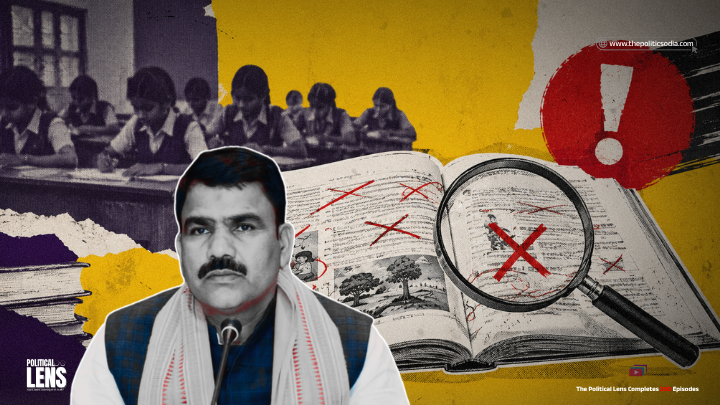
Bhubaneswar: Just days after Odisha Chief Minister Mohan Charan Majhi announced an ambitious vision of free education from KG to PG, the state’s education system has come under intense scrutiny following the discovery of a large number of errors in newly introduced school textbooks.
According to reports, as many as 1,678 errors have been identified in textbooks ranging from Class I to Class VIII. The mistakes include spelling errors, incorrect photographs, factual inaccuracies, geographical mistakes, and misleading references.
Among the reported errors, the image of the Odisha Legislative Assembly was allegedly replaced with that of the Karnataka Legislative Assembly. Niyamgiri was reportedly identified as being located in Jharkhand instead of Odisha. Ganjam district was incorrectly referred to as Berhampur district, while the Dongria tribal community was mentioned with an incorrect spelling.
The highest number of errors, around 705, has reportedly been found in Class VIII textbooks. These books were prepared under the framework of the National Education Policy (NEP) 2020 and have already been distributed among students across the state.

The controversy has triggered criticism from teachers’ associations, opposition parties, parents, and education observers. The Primary Teachers’ Association has demanded accountability and action against those responsible for allowing such a large number of errors to pass through the review process.
The School and Mass Education Department has directed teachers to correct the errors while teaching students in classrooms. However, the department has clarified that the textbooks themselves will not be replaced.
This decision has raised further questions. Critics argue that while teachers may correct spelling mistakes during lessons, factual inaccuracies and misleading illustrations can continue to influence students who repeatedly refer to the printed material.
The issue has also drawn attention to the textbook preparation and approval process. Education experts have questioned how such a significant number of mistakes escaped multiple layers of editing, proofreading, verification, and official approval.
The controversy has reached the highest levels of government. Chief Minister Mohan Charan Majhi reportedly reviewed the matter personally at Lok Seva Bhawan and examined copies of the textbooks containing the reported errors.
For many observers, the debate extends beyond textbook corrections. They argue that educational materials form the foundation of a student’s learning journey and must maintain the highest standards of accuracy and reliability.
As the government faces growing pressure for accountability, the incident has become a broader discussion about quality assurance, institutional responsibility, and the credibility of educational reforms.
The coming days may determine whether the issue remains limited to textbook corrections or leads to larger reforms in the state’s educational review and publication mechanisms.
The Political Lens By Sunil Jena
The textbook controversy highlights how implementation challenges can sometimes overshadow policy announcements. In education, public confidence depends not only on ambitious reforms but also on the accuracy and credibility of the learning materials delivered to students. Institutional accountability and stronger quality-control mechanisms may become central to the ongoing debate.
Author Profile

- Sunil Jena is the Editor of The Politics Odia, an independent digital platform that delivers fearless political analysis, ground reports, and investigative stories from Odisha. Known for bold storytelling and grassroots connections, Sunil is shaping a new era of regional journalism.
Latest entries
 AnalysisSeptember 17, 2026Dilu’s Game, Mohan’s Trouble? 30 Munda Tribals Allegedly Missing, 100+ Acres of Tribal Land Under Question, PM Modi Must Take Note : Super Exclusive
 AnalysisSeptember 11, 2026Thank You, Naveen Babu? BJD’s MMDR Protest Raises Questions Over Leadership and Political Strategy
 AnalysisSeptember 9, 2026CM in Dubai, Mining Mafia in Keonjhar? Who Is Protecting Odisha’s Mineral Wealth?
 AnalysisSeptember 7, 2026Why Is Mineral-Rich Odisha Still Poor? Radhakanta Sethi Takes on the MMDR Bill in Debate with Sunil Jena