Sunil Jena
Editor-in-Chief, The Politics Odia
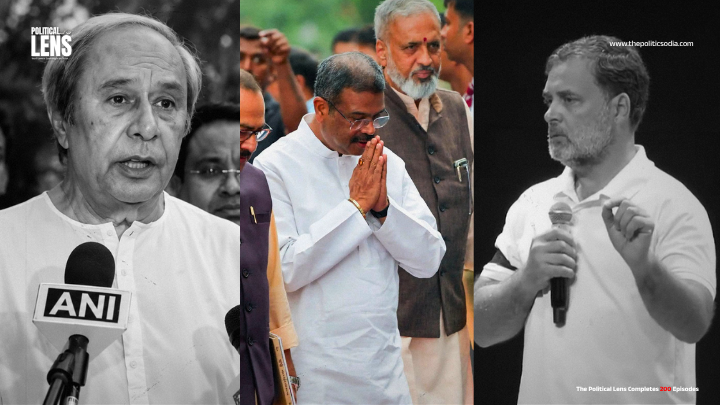
Bhubaneswar : Former Odisha Chief Minister and Leader of Opposition Naveen Patnaik has demanded the resignation of Union Education Minister Dharmendra Pradhan amid the political storm over the NEET examination controversy. The statement, made during Patnaik’s Delhi visit, has added a fresh Odisha dimension to a national debate that is already witnessing a sharp confrontation between the BJP and the Opposition.
On one side, the Opposition is questioning the Centre over alleged irregularities in the examination system and demanding political accountability. On the other, Dharmendra Pradhan has accused Congress leader Rahul Gandhi of using students as a political shield.
But amid this high-decibel battle over NEET, another education crisis closer home is struggling to receive the same political attention.
As many as 1,458 schools in Odisha are functioning with just one teacher, affecting nearly 60,000 students.

The question, therefore, is no longer confined to NEET. It is also about what happens to children when there are schools, students and textbooks — but not enough teachers.
Naveen Patnaik Demands Accountability
Naveen Patnaik’s demand for Dharmendra Pradhan’s resignation has sharpened the political battle over the NEET controversy.
The former chief minister’s intervention is particularly significant in Odisha politics because Pradhan is not merely the Union Education Minister; he is also one of the BJP’s most prominent political faces from the state.
The Opposition has been attempting to turn the NEET issue into a larger question of accountability over the examination system. Students’ protests have further increased pressure on the government.
For Naveen Patnaik, therefore, the question is straightforward: if the education system faces a crisis of credibility, who takes responsibility?
Dharmendra Pradhan Targets Rahul Gandhi
Dharmendra Pradhan, however, has hit back at Rahul Gandhi and the Congress.
The Union Education Minister has accused the Opposition of using students for political purposes and creating disruption instead of participating in a meaningful debate.
Pradhan has maintained that the government is prepared for a full discussion on NEET and issues concerning students. According to him, students need solutions, stability and reforms rather than political confrontation.
He has also argued that the government remains committed to transparency in the examination system and to addressing the legitimate concerns of students.
The political positions are now clearly drawn.
The Opposition wants accountability from the education minister. The BJP says the Opposition is politicising the students’ concerns.
But this confrontation leaves another important question unanswered.
What About Odisha’s 1,458 Single-Teacher Schools?
While politicians debate the future of students in Delhi, thousands of children in Odisha face a far more basic problem every morning when they enter their classrooms.
There is simply not enough teaching staff.
According to the available education data, 1,458 schools in Odisha are functioning with only one teacher, with close to 60,000 students enrolled in these institutions.
A significant number of such schools are located in remote, tribal and sparsely populated areas.
The term “single-teacher school” may sound like an administrative classification. In reality, it represents an enormous burden on both teachers and students.
One teacher may have to handle several classes, teach different subjects, maintain official records, manage administrative responsibilities and perform other government-assigned duties.
The obvious question is: how can one teacher effectively run an entire school?
The Children Who Rarely Enter the Political Debate
The students attending these schools are rarely part of television debates.
Many come from families that cannot afford private education. In remote and tribal areas, the local government school may be the only practical option available to them.
If there is only one teacher, the consequences can extend far beyond a shortage of classroom instruction.
Learning quality suffers. Parents lose confidence in government schools. Children may struggle academically. In the longer term, the risk of dropping out can also increase.
This is why the demand for teacher recruitment cannot simply be treated as another administrative file moving through the government system.
It is fundamentally about the future of thousands of children.
NEET Is Important, But So Is the Empty Classroom
There is no question that the NEET controversy deserves serious scrutiny.
An examination determining the future of lakhs of students must be transparent and credible. Any irregularity must be investigated, reforms must follow and accountability must be fixed wherever necessary.
But the political establishment also needs to answer why the education debate becomes intense only when a controversy reaches Parliament or dominates national headlines.
For Odisha, the crisis of single-teacher schools deserves the same urgency.
If political leaders can fight over examination reforms in Delhi, why should there not be an equally forceful debate over adequate teacher deployment in Odisha’s schools?
Education Cannot Become Only a Political Weapon
The confrontation involving Naveen Patnaik, Dharmendra Pradhan and Rahul Gandhi represents three different political positions.
Naveen is demanding Pradhan’s resignation.
Pradhan says Rahul Gandhi and Congress are using students for political purposes.
Congress and other Opposition parties are seeking accountability from the Centre.
These are legitimate subjects of political debate.
But education cannot be reduced to a weapon used only against political opponents.
Accountability must apply equally to examination management, textbook quality, teacher recruitment, school infrastructure and learning outcomes.
For a student sitting in a remote Odisha classroom, the BJP-Congress-BJD political battle matters far less than whether a teacher is actually present to teach.
The Bigger Question
Odisha’s education debate has recently been dominated by controversies over textbooks, errors in educational material and questions of administrative accountability.
Now the single-teacher school figures bring the focus back to the foundation of the education system itself.
Buildings can be constructed.
New schemes can be announced.
Curricula can be changed.
Digital classrooms can be inaugurated.
But none of these can replace a qualified teacher standing in front of students.
That is why the issue of 1,458 single-teacher schools and nearly 60,000 affected students deserves to become a major public policy debate rather than another statistic buried in official data.
As Naveen Patnaik demands Dharmendra Pradhan’s resignation and Pradhan targets Rahul Gandhi over the NEET protests, Odisha must ask its own question:
There are schools. There are students. There are textbooks. But where are the teachers?
Sunil Jena’s Observation
The NEET controversy has brought the issue of accountability in education to the centre of national politics. Naveen Patnaik’s demand for Dharmendra Pradhan’s resignation has further intensified that debate.
But Odisha cannot afford to look only towards Delhi. If 1,458 schools are functioning with a single teacher and nearly 60,000 students are affected, the teacher shortage deserves urgent intervention of its own.
Political accountability matters. But for students, the ultimate test of any education policy is much simpler — whether there is a teacher inside the classroom.
Author Profile

- Sunil Jena is the Editor of The Politics Odia, an independent digital platform that delivers fearless political analysis, ground reports, and investigative stories from Odisha. Known for bold storytelling and grassroots connections, Sunil is shaping a new era of regional journalism.
Latest entries
 AnalysisOctober 24, 2026Karan Adani’s Vision: How Dhamra Port Is Strengthening Odisha’s Maritime Economy
 Business PoliticsOctober 24, 2026Odisha Eyes ₹54,000 Crore in Investment Proposals; 20,000 Jobs in Focus After CM’s Mumbai Visit
 Business PoliticsOctober 23, 2026Karan Adani and Odisha: Building a New Chapter of Industrial Growth
 AnalysisOctober 22, 2026Naveen Patnaik Backs Cockroach Janata Party Leaders; BJP-BJD Clash Intensifies in Odisha