Sunil Jena
Editor in Chief, The Politics Odia
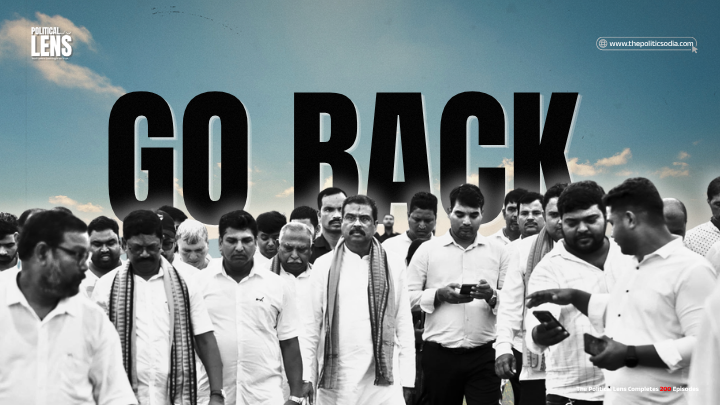
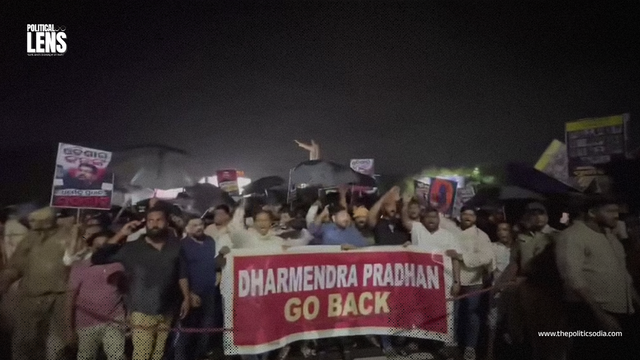
Bhubaneswar: The political battle between the BJP and BJD in Odisha has taken a fresh turn after slogans of “Go Back Dharmendra” were raised during former Union Minister Dharmendra Pradhan’s visit to Redhakhol.
The protest has triggered a series of political questions. Who organised the opposition to Dharmendra Pradhan? Was it a spontaneous expression of local anger, or was there a larger political strategy behind the protest?
Political allegations have now brought BJD supremo Naveen Patnaik and former 5T chairman VK Pandian into the discussion. However, there is no independently verified evidence establishing that Naveen Patnaik or VK Pandian directly organised the protest. The allegation remains part of the ongoing political confrontation between the BJP and BJD.
The controversy became sharper after Dharmendra Pradhan responded to the protests from the Redhakhol meeting stage.

In the presence of senior BJD leader Prasanna Acharya, Pradhan directly referred to the political criticism against him and questioned the strategy of using younger or lesser-known political workers to oppose him.
Pradhan also took a swipe at Naveen Patnaik, referring to remarks allegedly made against him and saying that political opposition would not stop him from coming to Odisha.
His message was clear: even if slogans of “Go Back Dharmendra” are raised, he would continue to visit Odisha and remain active in the state’s political affairs.
The political symbolism of the controversy is particularly interesting.
The phrase “Shikhandi” has entered the political narrative because of the Mahabharata analogy being used to describe the alleged strategy of fighting a political opponent indirectly rather than confronting them directly.
In the Mahabharata, Shikhandi was placed before Bhishma by Arjuna during the battle of Kurukshetra. Bhishma refused to fight Shikhandi, which created an opportunity for Arjuna to attack him.
The analogy is now being used politically to suggest that a party could be attempting to use other individuals to confront a stronger political opponent without directly taking responsibility for the confrontation.
But political analogies aside, the central question remains whether the Redhakhol protest was genuinely organised by any particular political party or emerged from local political dissatisfaction.
That distinction matters.
If the protest was organised by a political party, evidence about who planned it, who mobilised the protesters and who coordinated the slogans would be necessary to establish responsibility. If it was a spontaneous protest, then it would reflect a different political reality altogether — one involving local dissatisfaction rather than a centrally coordinated strategy.
For the BJP, the controversy provides an opportunity to portray Dharmendra Pradhan as a leader facing organised political resistance. For the BJD, any such protest can potentially be viewed as an expression of opposition to the BJP’s political leadership.
The bigger question is whether the confrontation will remain limited to slogans and counter-statements or become part of a wider political battle ahead.
Dharmendra Pradhan has repeatedly maintained his political connection with Odisha. His latest statement that he would continue coming to the state despite the “Go Back” slogans reinforces that position.
At the same time, the BJD continues to rebuild itself after losing power in Odisha. Naveen Patnaik remains the party’s central political face, while VK Pandian’s political role continues to attract considerable attention.
This makes every confrontation involving Dharmendra Pradhan politically significant.
The Redhakhol episode, therefore, may be more than a single protest. It has brought three important questions back into the Odisha political conversation: how much influence does Dharmendra Pradhan exercise in state politics, how is the BJD preparing to counter the BJP, and whether Naveen Patnaik’s political strategy is entering a new phase?
For now, the answers remain political claims rather than established facts.
What is certain is that the “Go Back Dharmendra” slogan has given the BJP and BJD another reason to sharpen their political attack on each other.
Sunil Jena’s Observation:
The allegation that the protest was planned by the BJD leadership needs evidence before it can be treated as an established fact. At the same time, Dharmendra Pradhan’s response shows that he is unwilling to step back from Odisha politics. The episode could become another indicator of how the BJP and BJD are positioning themselves for the next phase of political competition in the state.
Author Profile

- Sunil Jena is the Editor of The Politics Odia, an independent digital platform that delivers fearless political analysis, ground reports, and investigative stories from Odisha. Known for bold storytelling and grassroots connections, Sunil is shaping a new era of regional journalism.
Latest entries
 AnalysisSeptember 22, 2026Opposition Parties Hold Rally in Rayagada Seeking Repeal of MMDR Amendment Act 2026
 AnalysisSeptember 22, 2026Odisha Assembly Adjourned Till 1:10 PM Amid Opposition Uproar on First Day of Monsoon Session
 AnalysisSeptember 21, 2026BJP MPs, MLAs Flag Delays in Development Projects; Letters Trigger Fresh Political Row in Odisha
 AnalysisSeptember 11, 2026Thank You, Naveen Babu? BJD’s MMDR Protest Raises Questions Over Leadership and Political Strategy