By Sunil Jena
Editor-in-Chief, The Politics Odia
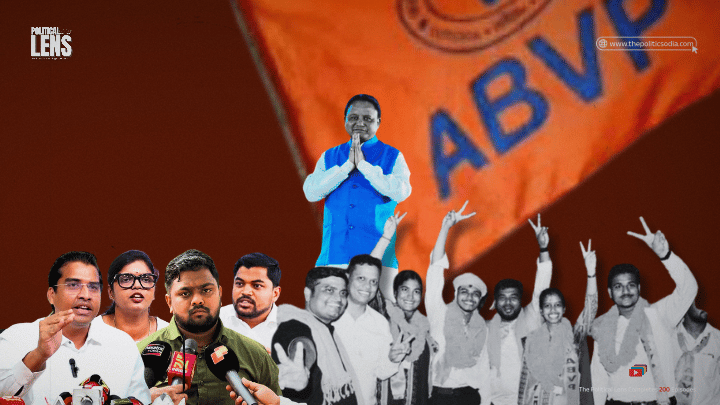
Bhubaneswar: A remark by Odisha Chief Minister Mohan Charan Majhi at a state-level student leaders’ conference organised by the Akhil Bharatiya Vidyarthi Parishad (ABVP) has triggered a political controversy over the government’s role in college elections.
Speaking at the event, Majhi reportedly said that the government announced the dates for college elections after ABVP was ready. What may have been intended as a remark appreciating the student organisation’s preparation has now become the centre of a debate over political neutrality and the independence of government decisions.
The Biju Janata Dal (BJD) has questioned whether the Chief Minister was speaking in his capacity as the head of the state government or as a supporter of a particular student organisation. The Congress has also raised questions about the functioning of the Higher Education Department and the Chief Minister’s Office.
ABVP, meanwhile, has defended the Chief Minister and accused opposition parties of unnecessarily politicising the issue.

But beyond the exchange of political statements lies a more important question: Should the decision to hold college elections depend on the preparedness of any one student organisation, or should it be guided by a uniform policy applicable to every college?
The Chief Minister’s Remark Becomes the Centre of Debate
The controversy began after Chief Minister Mohan Charan Majhi addressed ABVP’s state-level student leaders’ conference.
His reported statement linking the organisation’s preparedness with the government’s announcement of college election dates quickly attracted political attention.
The opposition argues that the remark creates an impression that the government’s decision was connected to the readiness of a particular student organisation. The government’s position, however, needs to be understood through the actual decision-making process and the criteria followed for conducting elections.
There is an important distinction between acknowledging the efforts of a student organisation and suggesting that its preparedness played a role in a government decision.
The Chief Minister’s exact intention may be a matter of political interpretation. However, when a Chief Minister makes such a statement on a public platform, it is natural for questions to arise about the separation between political affiliation and constitutional responsibility.
BJD Questions the Chief Minister’s Neutrality
The Youth BJD has strongly criticised the Chief Minister’s remarks, asking whether Majhi represents the interests of all people in Odisha or those of ABVP.
The party has argued that the Chief Minister, after taking the oath of office, carries the responsibility of serving the entire state, irrespective of political affiliation or organisational identity.
BJD leaders have also brought up earlier complaints regarding college elections, including allegations that elections were stopped in some institutions and vote counting was delayed in certain places.
These allegations require a clear response from the government. The relevant question is whether the same rules and standards were applied across institutions, and whether decisions to postpone or cancel elections were based on administrative reasons.
Congress Raises Questions Over 209 Colleges and Three Universities
The Congress has also questioned the circumstances surrounding the college election process.
According to the party, elections were not held in 209 colleges and three universities, while elections took place in other institutions. Congress has alleged that the pattern raises questions about whether the process was conducted uniformly.
The allegation is politically significant, but the numbers and reasons behind the institutions where elections were not held need to be examined against official records.
The government should clarify how many institutions conducted elections, how many did not, and the specific reasons for each decision. If there were concerns relating to law and order, infrastructure, academic schedules or other administrative issues, those reasons should be placed in the public domain.
A transparent explanation would help establish whether the decisions were based on consistent criteria rather than political considerations.
ABVP Rejects the Opposition’s Allegations
ABVP has rejected the criticism and maintained that it had campaigned for the restoration of students’ democratic rights.
According to the organisation, its members had organised protests outside colleges demanding that student elections be held. It argues that the return of elections is a positive development and that opposition parties are now attempting to turn the issue into a political controversy.
ABVP has also accused the Congress of raising questions because it could not perform well in the elections.
The organisation’s position is that the focus should remain on restoring student representation rather than questioning the government over its decision to conduct elections.
However, the debate is not simply about whether elections should be welcomed. It is also about how the government arrived at its decision and whether every eligible institution received equal treatment.
College Elections Are About More Than Political Victory
College elections are often treated as an early testing ground for political organisations. For student groups, campuses offer an opportunity to build networks, identify future leaders and establish a presence among young voters.
ABVP, BJD’s student wing and Congress-affiliated student organisations all have an interest in expanding their influence in educational institutions. Such competition is a normal part of democratic politics.
But student elections have a purpose that goes beyond the political ambitions of these organisations.
They give students an opportunity to choose their representatives, raise campus-related concerns and learn the basics of democratic participation. A student union can become a platform for discussing issues that directly affect everyday campus life.
These include the shortage of teachers, hostel facilities, library and laboratory infrastructure, campus safety, access to scholarships and employment opportunities.
Unfortunately, much of the current debate has shifted towards who deserves credit for bringing back elections, which organisation was prepared and which political group gained an advantage.
The concerns of students themselves should not get lost in this political contest.
The Government Must Maintain Equal Distance
The government has a responsibility to ensure that the rules governing college elections are fair, transparent and uniformly applied.
It is not the government’s role to favour one student organisation over another. Nor should the preparedness or electoral prospects of any particular group determine whether students get an opportunity to elect their representatives.
Where elections are held, all eligible student organisations should receive a fair opportunity to participate. Where elections cannot be conducted, the reasons should be clearly explained.
The controversy surrounding the Chief Minister’s remark could have been avoided if the government had clearly communicated the policy and administrative criteria behind the election schedule.
Ultimately, the credibility of the process will depend not on political statements but on whether the same standards apply to every institution.
Three Questions the Government Needs to Answer
The controversy raises three important questions.
First, what exactly did the Chief Minister mean when he linked ABVP’s preparedness with the announcement of college election dates? Was it merely an acknowledgement of the organisation’s efforts, or did its preparedness form part of the government’s decision-making process?
Second, why were elections reportedly not held in 209 colleges and three universities? What were the specific administrative or other reasons, and were the same criteria applied to all institutions?
Third, what happens next year if ABVP or any other student organisation is not prepared for elections? Will the government still conduct them according to a fixed academic and administrative schedule?
These are questions that deserve clear answers, not political counterattacks.
Sunil Jena’s Observation
A Chief Minister may belong to a political party and hold personal ideological beliefs, but the office carries a responsibility towards the entire state. That responsibility must be reflected in the government’s decisions, particularly when those decisions affect democratic participation.
Similarly, the restoration of college elections should not be presented as the achievement of any one student organisation. The right to elect representatives belongs to all students, including those who do not support any political group.
The real test of the Odisha government will be whether it can ensure a fair and transparent election process across colleges and universities. The debate should not be about which organisation is politically stronger, but whether students are being treated equally.
Because college elections are not the property of political parties or student organisations. They belong to the students.
Author Profile

- Sunil Jena is the Editor of The Politics Odia, an independent digital platform that delivers fearless political analysis, ground reports, and investigative stories from Odisha. Known for bold storytelling and grassroots connections, Sunil is shaping a new era of regional journalism.
Latest entries
 AnalysisNovember 13, 2026Is Odisha’s Chief Minister Answerable to the State or to ABVP? College Elections Trigger a Political Row
 AnalysisNovember 12, 2026Ganjam Flood Politics Intensifies: Anu Garg Defends Government, Anil Biswal Hits Back at Suresh Mahapatra as Relief Package Announced
 AnalysisNovember 11, 2026Ganjam Flood: Natural Disaster or Administrative Failure? Naveen Patnaik’s Allegations Put Odisha Government Under Pressure
 AnalysisOctober 28, 2026Sujata Rout Karthikeyan’s Emerging Role in BJD as Naveen Patnaik Targets BJP