By Sunil Jena
Editor-in-Chief, The Politics Odia
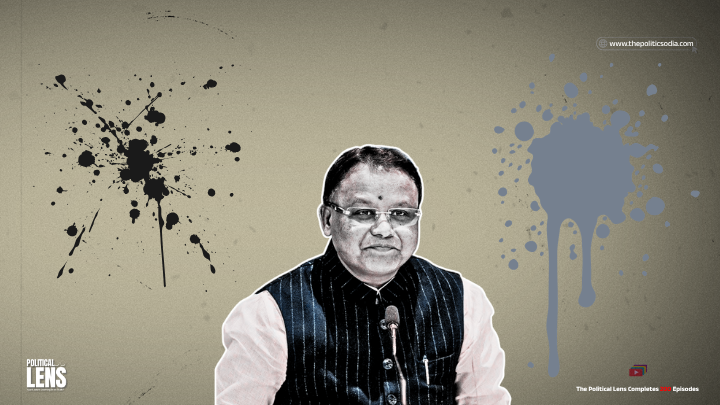
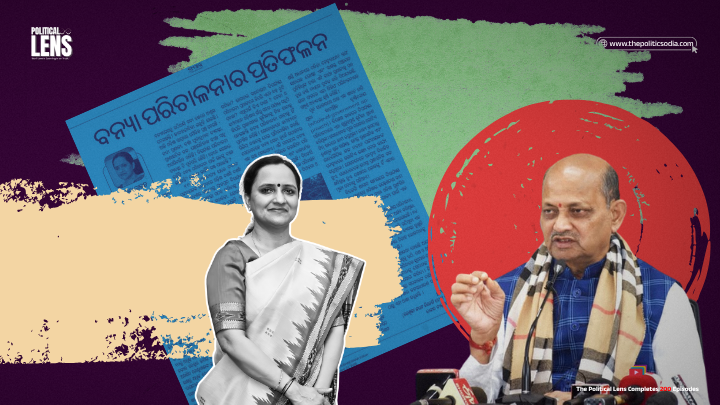
Bhubaneswar: The political fight over Odisha’s flood management has taken a new turn, with BJP state president Manmohan Samal taking a dig at BJD leader Sujata Rout over her criticism of the state government’s handling of the recent floods.
Sujata Rout, who has recently entered active politics after leaving the civil services, criticised the BJP government’s flood management in an article published in a leading Odia daily. She questioned the preparedness of the administration and argued that Odisha’s disaster management system, built over several years, has suffered a setback under the present government.
Samal, however, chose to respond in a different tone.
His message was simple: before criticising the government, visit the flood-affected areas, meet the people and understand the situation on the ground.

The BJP leader’s remark has now become another point of political discussion, particularly because Sujata’s intervention is being seen as part of the BJD’s effort to sharpen its attack on the Mohan Charan Majhi government.
Sujata has argued that the state government failed to respond effectively to the flood situation and questioned the preparedness of the administration. She referred to Odisha’s experience after the 1999 Super Cyclone and said the state had gradually built a disaster-management system based on early warning, evacuation, coordination and administrative preparedness.
The ‘zero casualty’ approach of the previous BJD government has also featured prominently in her argument.
According to Sujata, the earlier system worked because the government, district administration and local representatives operated as a coordinated team. She has questioned what went wrong during the floods of July-August 2026 and why a system that was once considered one of Odisha’s strengths appeared to be struggling.
Her criticism did not stop there.
Sujata also questioned the role of political workers in relief distribution. She alleged that BJP workers were interfering in the administrative process and that relief distribution was becoming a political competition.
She further raised questions over the participation of Mission Shakti self-help groups in flood management and relief operations.
The BJP, however, has rejected the broader political narrative being created by the opposition.
Samal’s criticism of Sujata appears to have shifted the debate from flood management alone to the question of political experience and ground-level engagement.
The BJP president has essentially asked a political question: can criticism of disaster management be made from a distance, or does political leadership require leaders to first visit affected communities and understand their problems?
That question has now become politically significant because Sujata is not just another opposition voice.
Her entry into active politics has attracted attention because of her association with former bureaucrat and BJD leader VK Pandian. Her recent interventions have also placed her increasingly in the opposition party’s political conversation.
For the BJD, the flood issue provides an opportunity to attack the BJP government on one of the areas where the Naveen Patnaik administration had built a strong political reputation.
For the BJP, however, the challenge is to demonstrate that its disaster-management machinery is functioning effectively at the ground level rather than allowing the opposition to define the narrative.
The real test is therefore not the exchange of political statements.
It is what happens to people living in the flood-affected areas.
When houses remain surrounded by water, roads remain submerged and families struggle for food, drinking water and medical assistance, political arguments over who is more experienced matter less to the people waiting for relief.
Sujata has asked the government to accept its shortcomings and improve the system.
Samal has asked her to first go to the affected areas and see the situation herself.
Both statements point to the same larger issue: the gap between political claims and the experience of people on the ground.
Odisha has faced floods and cyclones for decades. Its disaster-management model was built through years of institutional experience, repeated disasters and administrative learning. Maintaining that capacity requires more than political speeches. It requires coordination between ministers, officials, district administrations, elected representatives and local communities.
That is where the present political debate should ultimately lead.
If the government believes its flood response was adequate, it has the opportunity to present the facts, district-wise relief data and details of assistance delivered to affected families.
If the opposition believes the administration failed, it also needs to put evidence before the public and identify exactly where the system broke down.
The people of Odisha need answers, not merely accusations.
The latest exchange between Manmohan Samal and Sujata Rout may have started as a political attack and counterattack. But behind the rhetoric lies a much more important question: has Odisha’s disaster-management system remained as effective as its reputation suggests?
That question cannot be answered from a party office.
It can only be answered on the ground.
Sunil Jena’s Observation:
The flood debate should move beyond political blame. The government must show results on the ground, while the opposition must back its allegations with facts. Ultimately, what matters is whether relief reaches every affected family.
Author Profile

- Sunil Jena is the Editor of The Politics Odia, an independent digital platform that delivers fearless political analysis, ground reports, and investigative stories from Odisha. Known for bold storytelling and grassroots connections, Sunil is shaping a new era of regional journalism.
Latest entries
 AnalysisSeptember 22, 2026Opposition Parties Hold Rally in Rayagada Seeking Repeal of MMDR Amendment Act 2026
 AnalysisSeptember 22, 2026Odisha Assembly Adjourned Till 1:10 PM Amid Opposition Uproar on First Day of Monsoon Session
 AnalysisSeptember 21, 2026BJP MPs, MLAs Flag Delays in Development Projects; Letters Trigger Fresh Political Row in Odisha
 AnalysisSeptember 11, 2026Thank You, Naveen Babu? BJD’s MMDR Protest Raises Questions Over Leadership and Political Strategy