By Sunil Jena
Editor-in-Chief, The Politics Odia
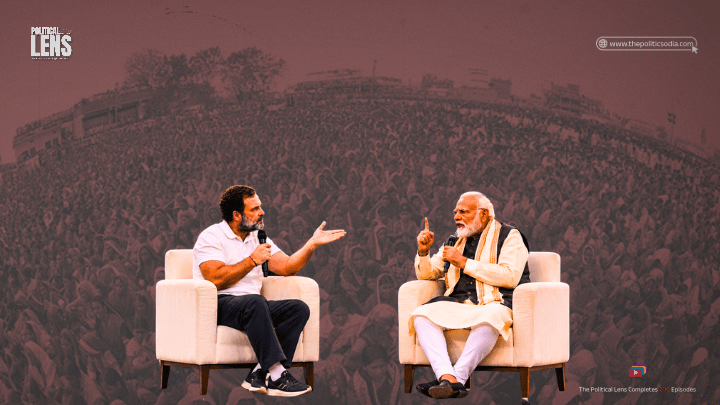
Bhubaneswar : A mobile phone held up before the camera has become the centre of a fresh political debate in India. Leader of the Opposition in the Lok Sabha, Rahul Gandhi, has alleged that his phone is being tapped and claimed that evidence supporting his allegations is contained in the device. He has also challenged Prime Minister Narendra Modi to participate in an open debate, bringing questions of political accountability, digital surveillance and citizens’ privacy into the national conversation.
The controversy gained attention after Rahul Gandhi held an Ask Me session on Instagram on November 13. Responding to a question about why he wanted a separate debate with the Prime Minister when the BJP had expressed its willingness to discuss issues in Parliament, Rahul displayed his phone and claimed that it contained evidence relating to his allegations. He further asserted that the Prime Minister was aware of the matter because his phone was being tapped.
However, the claim requires careful examination. During the Instagram session, Rahul did not publicly present independently verifiable technical evidence establishing that his phone had been intercepted. His statement, therefore, remains an allegation and should not be treated as a technically established fact without independent verification.
Why Has Rahul Gandhi Challenged Narendra Modi?
The phone-tapping allegation is only one part of Rahul Gandhi’s latest political challenge. He has also called for a direct, open debate with Prime Minister Narendra Modi, arguing that several important issues have not received adequate discussion in Parliament.

Rahul has referred to subjects including the farm laws, allegations of electoral irregularities, the Special Intensive Revision (SIR) of electoral rolls, China, the book by former Army Chief General M. M. Naravane and the Epstein controversy. He has alleged that he has not been able to raise these matters adequately and has claimed that his microphone is switched off when he begins speaking.
His demand for a separate debate appears to be an attempt to take these issues beyond the regular parliamentary exchange and place them before a wider public audience. Rahul has even indicated that he would have no objection if industrialist Gautam Adani or RSS chief Mohan Bhagwat acted as judges in the proposed debate.
The challenge has consequently become both a political confrontation and a question about how the country’s top political leaders engage with each other in public.
Phone Tapping: An Allegation That Raises Questions Beyond Politics
The significance of the allegation goes beyond the political rivalry between the Congress and the BJP. Mobile phones today contain an extraordinary amount of personal information, including financial details, private photographs, emails, professional communications and personal conversations.
Any unauthorised access to such information can raise serious concerns about an individual’s right to privacy. When the allegation comes from the country’s Leader of the Opposition, it also raises questions about the limits of state power and the mechanisms available to ensure accountability.
The government has legal powers to authorise certain forms of interception and surveillance under applicable laws and procedures, particularly in matters involving national security and serious offences. However, the existence of such powers does not automatically justify their unrestricted use. Their exercise must remain subject to legal safeguards, oversight and accountability.
The central question is not simply whether surveillance is permitted under the law. It is whether the safeguards are strong enough to prevent misuse and whether citizens have effective remedies when their privacy rights are violated.
The Pegasus Controversy and India’s Surveillance Debate
This is not the first time that digital surveillance has become a major political issue in India. During the Pegasus controversy, allegations emerged that spyware may have been used against the phones of journalists, politicians and other individuals. Rahul Gandhi had also claimed that his phone was targeted by Pegasus spyware.
The central government rejected the allegations. The controversy nevertheless brought renewed attention to the risks associated with sophisticated surveillance technology and the need for credible mechanisms to investigate claims of unauthorised monitoring.
The latest statement by Rahul Gandhi has brought those concerns back into political discussion. However, the earlier Pegasus controversy and the present phone-tapping allegation should not be treated as proof of each other. Each claim requires its own evidence and independent examination.
BJP’s Response: Why Not Raise the Issues in Parliament?
BJP leaders have rejected Rahul Gandhi’s phone-tapping allegation. Some leaders have also responded with criticism and sarcasm. Finance Minister Nirmala Sitharaman has urged Rahul to discharge his parliamentary responsibilities with seriousness, while Home Minister Amit Shah has indicated that such allegations should be raised in Parliament.
The BJP’s broader argument is that Parliament is the appropriate forum for discussing serious political and constitutional questions. Since the country already has an established legislative platform, the party has questioned the need for a separate public debate with the Prime Minister.
There is an institutional basis to the argument that Parliament should remain the primary forum for holding the government accountable. It provides procedures for questions, ministerial responses, policy discussions and scrutiny of executive decisions.
At the same time, the effectiveness of parliamentary democracy depends on meaningful debate and the opportunity for elected representatives to raise public concerns. If disagreements arise over the availability of speaking opportunities, the functioning of parliamentary proceedings itself becomes an important subject of discussion.
A political rebuttal alone may not resolve public concerns surrounding a serious surveillance allegation. A clear, evidence-based response is essential to address questions that affect public confidence.
What Should Happen Next?
Both sides have responsibilities in this controversy. If Rahul Gandhi possesses technical evidence of phone interception, it should be made available for independent examination through appropriate legal and technical channels. The nature of the alleged surveillance, the evidence supporting it and the circumstances in which it may have occurred need to be established.
The government, meanwhile, has a responsibility to respond to serious allegations with factual clarity. If the claims are unfounded, the basis for rejecting them should be explained. If evidence of wrongdoing emerges, the matter should be investigated through an impartial process in accordance with the law.
The issue should not be reduced to a contest over which political leader wins the argument. The right to privacy and the accountability of public institutions are concerns that extend beyond individual political personalities.
The Political Strategy Behind the Debate Challenge
Rahul Gandhi’s demand for a direct debate also has a clear political dimension. By challenging the Prime Minister to face him on a public platform, he is seeking to position himself as a direct political counterpart to Narendra Modi. The proposal places the focus on a face-to-face exchange rather than the usual parliamentary confrontation or party-level statements.
Whether such a debate takes place remains a political decision. But the larger test of Rahul’s position will depend on whether he presents verifiable evidence for his allegations and whether the government provides a substantive response.
The debate challenge may attract public attention, but the credibility of the underlying claims will ultimately depend on facts, evidence and institutional scrutiny.
Sunil Jena’s Observation
The Rahul Gandhi phone-tapping controversy raises a question larger than the political rivalry between the Congress and the BJP: how securely are citizens’ private communications protected, and how effectively is the exercise of government surveillance powers monitored? Rahul Gandhi must substantiate his allegation with verifiable evidence, while the government must respond transparently to concerns about privacy and accountability. In a democracy, questioning those in power is a right, but serious allegations require evidence—and public authority carries an equally serious responsibility to answer.
Author Profile

- Sunil Jena is the Editor of The Politics Odia, an independent digital platform that delivers fearless political analysis, ground reports, and investigative stories from Odisha. Known for bold storytelling and grassroots connections, Sunil is shaping a new era of regional journalism.
Latest entries
 AnalysisNovember 15, 2026After Narendra Modi, Who? Amit Shah’s Political Journey and the BJP’s Next Leadership Question
 AnalysisNovember 15, 2026Rahul Gandhi’s Phone-Tapping Allegation and Modi Debate Challenge: A Bigger Question About Privacy and Democracy
 AnalysisNovember 13, 2026Is Odisha’s Chief Minister Answerable to the State or to ABVP? College Elections Trigger a Political Row
 AnalysisNovember 12, 2026Ganjam Flood Politics Intensifies: Anu Garg Defends Government, Anil Biswal Hits Back at Suresh Mahapatra as Relief Package Announced

