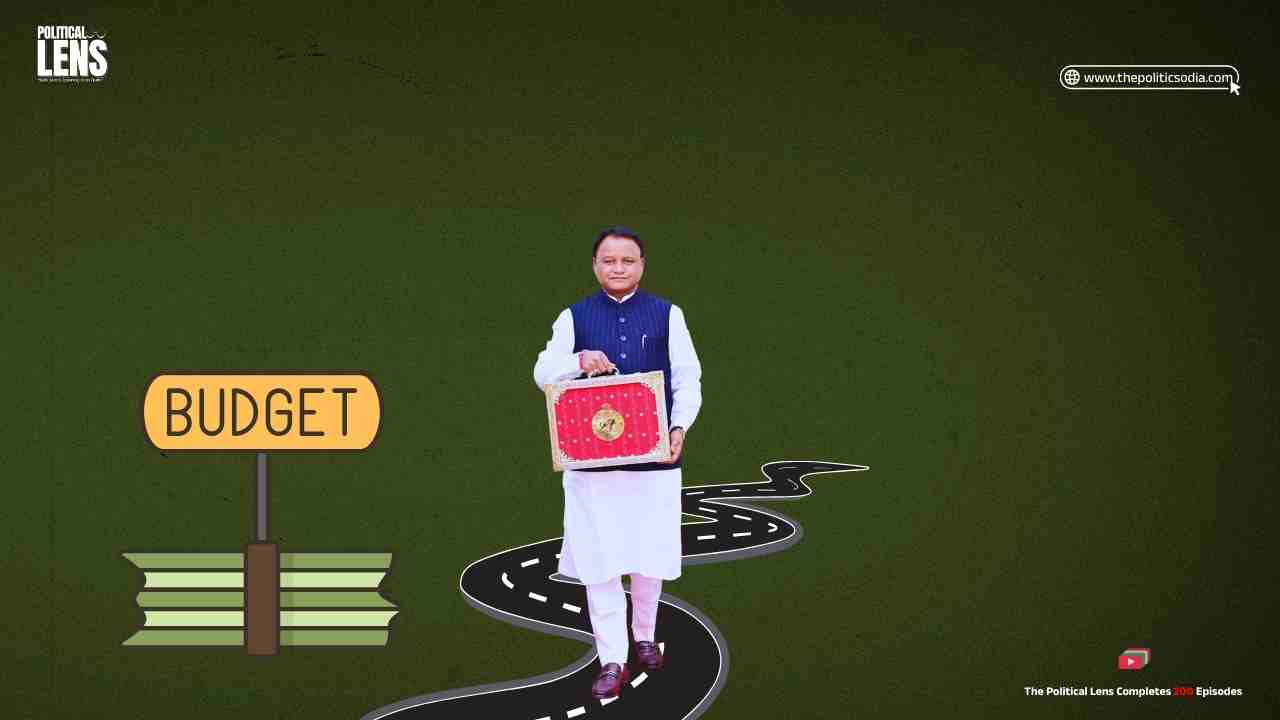
Bhubaneswar: The presentation of a 3.10 lakh crore budget by Chief Minister Mohan Charan Majhi has set off one of the sharpest political and economic debates in Odisha in recent times. The government is projecting the budget as a sign of confidence and expansion. The opposition sees it as a document full of announcements but constrained by execution capacity.
The immediate political response came from Leader of Opposition Naveen Patnaik, whose brief remark comparing the budget to a menu without a kitchen quickly shaped the narrative. It was a political line, but it also reflected a larger concern that economists often raise – the gap between allocation and utilisation.
Data from the current financial year shows that nearly half of the budgeted expenditure remains to be spent in the last quarter. This is not unusual in public finance, but it becomes a challenge when the pending amount is very large. Departments have a limited time to convert allocations into on-the-ground projects.
At the same time, the budget carries a clear policy direction.
Infrastructure continues to receive priority. Roads, connectivity for remote regions, new institutions, tourism facilities in Puri and investments in MSME are expected to create long-term economic activity. The focus on rural economy and women’s empowerment indicates that the government wants to maintain a balance between growth and welfare.

There is also a strong alignment with centrally sponsored schemes. In a double-engine framework, this is expected, as it allows faster access to funds and integrated project execution. However, it also means that the state’s own fiscal space becomes an important subject of discussion.
The rise in debt has become the central political talking point. The opposition compares the present liability with the level during the previous administration and argues that the state had inherited a healthier financial position. Government supporters counter that a growing economy requires higher borrowing for capital expenditure and that the debt-to-GSDP ratio remains within manageable limits.
This is where perception and economics begin to diverge.
For the common citizen, the question is simple. Will this budget improve employment, agricultural returns, health services and daily infrastructure?
The opposition has claimed that agriculture and health allocations do not match expectations and that unemployment does not find a strong enough response in the document. The government points to sectoral schemes and argues that outcomes must be judged over time, not within a single budget cycle.
Independent observers note that Odisha’s fiscal health cannot be measured only by the size of borrowing. What matters is how much of that borrowing is used for productive assets. If capital formation increases, future revenue expands, and debt becomes easier to manage.
The coming year will therefore be less about political speeches and more about implementation.
If the spending pace improves and projects move to the ground quickly, the budget will be seen as growth-oriented. If utilisation continues to lag, the opposition’s narrative will gain strength.
Budgets are not just financial statements. They are political documents that set expectations.
The Mohan Majhi government has presented its vision through numbers. The Naveen Patnaik-led opposition has challenged its practicality.
The final verdict will not come from the Assembly debate. It will come from the speed at which the allocated money turns into visible change across Odisha.