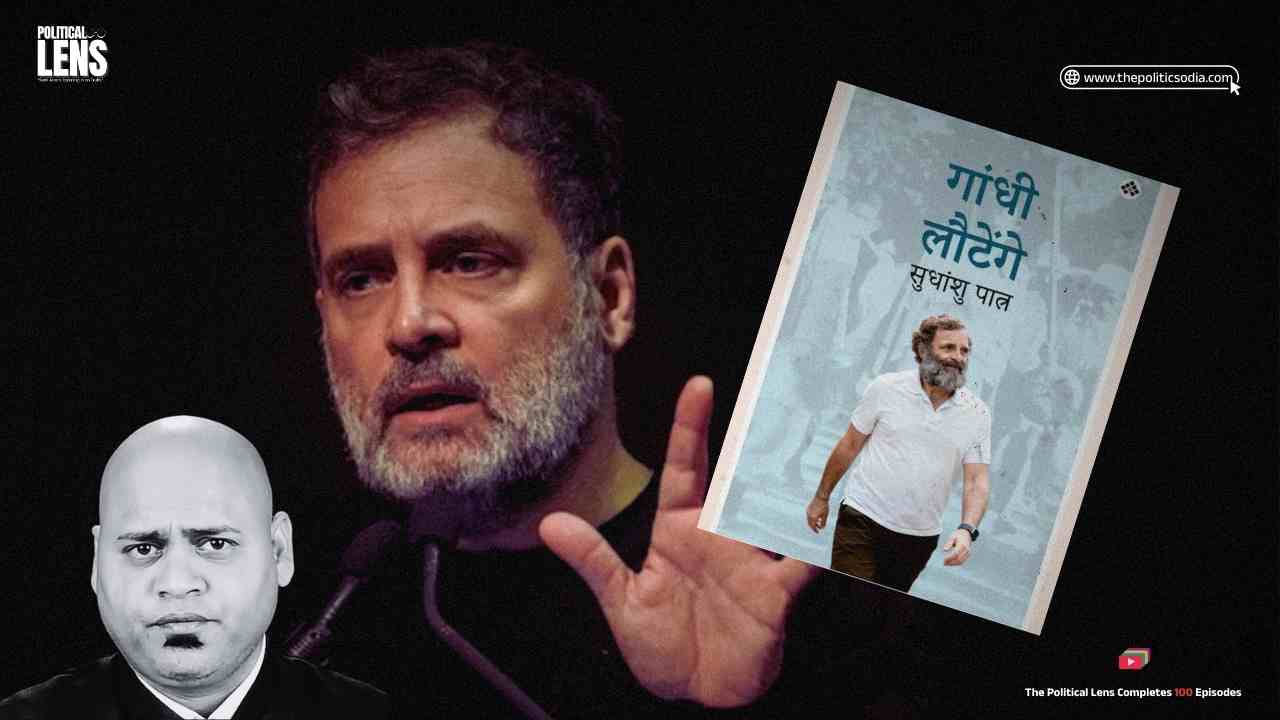
Bhubaneswar: In times of political churn, books often become more than just bound pages; they turn into arguments, provocations, and mirrors of public anxiety. Gandhi Lautenge is emerging as one such text, stirring debate across political, journalistic, and academic circles.
Authored by senior journalist Sudhanshu Patra, the book places at its centre one of the most explosive claims in contemporary Indian politics: allegations of electoral manipulation and institutional bias. Drawing heavily from statements and positions articulated by Rahul Gandhi, the book examines the claim that democratic processes, particularly elections, are being systematically influenced, with the Election Commission of India portrayed as a silent or complicit observer.
From the Ground Up: Bihar as the Starting Point
Before penning Gandhi Lautenge, Sudhanshu Patra spent over 20 days on the ground in Bihar, closely following the voter rights march that questioned electoral roll revisions, voter deletions, and administrative opacity. According to the author, it was in Bihar’s villages far from television studios and press conferences that the book’s emotional core was shaped.
The book does not claim to be a judicial verdict. Instead, it positions itself as a journalistic documentation of perceptions of how ordinary citizens interpret allegations raised by opposition leaders, and how silence or denial from institutions is read on the ground.
In that sense, Gandhi Lautenge is as much about belief as it is about evidence.

A Narrative Rooted in Allegation, Not Adjudication
Patra frames the Bharatiya Janata Party’s repeated electoral victories through the lens of opposition allegations of vote rigging, administrative tilt, and structural advantages. The book consistently uses conditional language, reflecting that these are charges raised in the political domain, not findings established by courts.
This distinction is critical. The power of the book lies not in proving fraud, but in documenting the growing distrust in democratic institutions—a distrust that, Patra argues, could shape future politics more decisively than any single election result.
Language, Launches, and a Political Moment
The reach of Gandhi Lautenge is expanding rapidly. The book is set to be published in 10 languages, signalling an ambition to move beyond an elite readership into mass political discourse. Its Odia edition has already been released in Odisha, launched by Bhakta Charan Das, who described the book as a potential catalyst for a “new democratic awakening.”
The Hindi edition is scheduled for release on the 10th at Delhi’s Constitution Club of India—a venue symbolic of political legitimacy and intellectual debate.
Each launch is not merely literary; it is overtly political.
Rahul Gandhi and the 2029 Argument
One of the book’s most debated assertions is Patra’s claim that Rahul Gandhi represents the only viable alternative for the post of Prime Minister in 2029. This is not presented as prophecy, but as an interpretation of evolving political alignments, opposition consolidation, and narrative momentum.
Patra’s confidence stems partly from his professional record. Having covered 15 state assembly elections and authored four political books, he claims to have accurately predicted outcomes in each case. Supporters cite this track record as reason to take his political assessments seriously; critics argue that past accuracy does not guarantee future foresight.
Why the Book Resonates Now
The traction of Gandhi Lautenge cannot be separated from the current political climate. Allegations of institutional bias, debates over democratic backsliding, and rising polarisation have created an audience primed for such narratives.
The book’s success so far suggests one thing clearly: a large section of the public is not merely interested in who wins elections, but in how those elections are conducted—and whether the referee is truly neutral.
A Provocation, Not a Conclusion
Ultimately, Gandhi Lautenge does not offer closure. It offers provocation.
It asks uncomfortable questions without claiming final answers. It reflects a growing sentiment of suspicion without declaring guilt. Whether one agrees with its thesis or rejects it outright, the book has succeeded in reigniting a fundamental debate about democracy, trust, and power in India.
In that sense, its real impact may not be electoral but intellectual.
Because sometimes, in politics, the most disruptive force is not a vote but a doubt.