By Sunil Jena
Editor-in-Chief, The Politics Odia
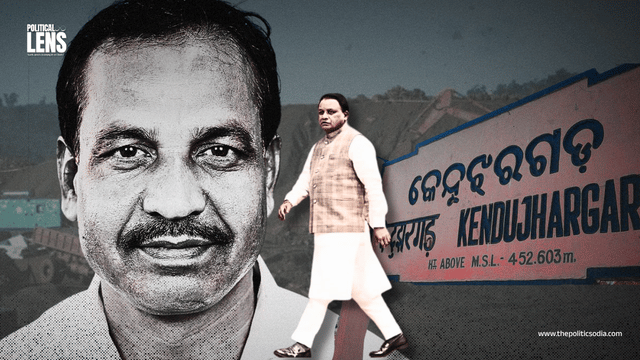
Bhubaneswar : Keonjhar is Odisha’s mining powerhouse. Iron ore, manganese and chromite have made the district one of the most important mineral hubs in the state. Thousands of crores in revenue flow from its mines every year, while the District Mineral Foundation (DMF) has been created to ensure that mining-affected communities also benefit from this wealth.
Yet a basic question remains: who is actually watching the mines?
According to the 2021-22 DMF report cited in the discussion, Keonjhar had 101 mines, of which 42 were operational. Earlier data had put the number of leases at 108, with 83 operational. A large concentration of these mines is around the Joda mining circle, where major companies including OMC, Tata, SAIL and Rungta have operations.
Keonjhar is also among India’s major districts in terms of DMF collections. The purpose of this fund is straightforward — money generated from mining should help improve healthcare, education, drinking water, roads and other basic infrastructure in mining-affected areas.

But the picture becomes more complicated when enforcement capacity is examined.
Reports cited in the discussion suggest that out of 18 sanctioned posts in the mining administration, 11 were vacant. That means nearly two-thirds of the posts were reportedly lying vacant. When the department responsible for monitoring mining activity does not have enough personnel, questions naturally arise over field inspections, checking of mineral transportation and prevention of illegal extraction.
Some officers are reportedly handling multiple responsibilities, adding to the pressure on an already stretched system.
The responsibility for preventing illegal mining does not rest with one agency alone. The Steel and Mines Department, Deputy Directors of Mines at Joda and Keonjhar, police, forest officials and, in the case of minor minerals, tehsildars all have roles to play.
Odisha has also introduced new measures, including the Odisha Mineral (Prevention of Illegal Mining, Transportation and Storage) Rules, 2025, with provisions involving technology, e-passes and stricter enforcement. But technology can only work when there is sufficient manpower and regular ground-level monitoring.
This is where the real contradiction emerges.
On one side, Keonjhar generates enormous mineral wealth. On the other, the institutional machinery responsible for monitoring that wealth appears to be struggling with vacancies and overlapping responsibilities.
The DMF mechanism presents another interesting picture. The district collector heads the DMF Trust, while its day-to-day functioning is handled through the designated administrative structure. The discussion also points to a relatively small management setup compared with the scale of funds and projects involved.
Earlier, engineers deployed at the block level were also reportedly removed from the system, raising another question: has the administrative capacity kept pace with the enormous scale of mining revenue?
The central problem, therefore, may not be a shortage of resources. It may be a shortage of institutional capacity.
When responsibility is divided among several departments but accountability is not clearly fixed, enforcement can become everybody’s responsibility — and ultimately nobody’s responsibility.
That is particularly worrying in a district where the economic stakes are enormous.
Mining companies may generate revenue for the state, but the environmental and social consequences are experienced directly by local communities. Dust, damaged roads, pressure on water resources and other effects of mining are felt on the ground.
The issue of closed mines also deserves attention. A mine being officially closed does not automatically mean that the possibility of illegal extraction disappears. Without effective surveillance, abandoned or closed mining areas can become vulnerable to unauthorised activity.
And this brings the debate back to the political question surrounding the episode.
At a time when Chief Minister Mohan Charan Majhi is travelling internationally to attract investment and project Odisha as an investment destination, what is happening on the ground in one of Odisha’s richest mining districts?
The question is not whether Odisha should stop mining. The question is whether a state that earns so much from its mineral resources can afford to have critical enforcement posts lying vacant.
If the government wants greater investment, greater mineral production and greater revenue, it must also strengthen the institutions responsible for monitoring the sector.
Vacant chairs cannot stop illegal mining.
Rules on paper cannot replace officers in the field.
And technology cannot substitute for accountability.
For Keonjhar, the real challenge is not simply extracting more minerals. It is ensuring that the wealth generated from those minerals is legally extracted, properly accounted for and meaningfully converted into development for the people living in the mining belt.
The question therefore remains: in a mineral-rich district, why are so many enforcement positions vacant?
Until that question is answered, allegations of illegal mining and mineral theft will continue to raise concerns over whether Odisha’s mineral wealth is being adequately protected.
Sunil Jena’s Observation:
Keonjhar’s story is a contradiction: enormous mineral wealth, substantial DMF revenue, but questions over manpower and enforcement. The government’s real test is not merely how much revenue mining generates, but whether it has built a strong enough system to protect that wealth and ensure its benefits reach the communities that bear the cost of mining.
Author Profile

- Sunil Jena is the Editor of The Politics Odia, an independent digital platform that delivers fearless political analysis, ground reports, and investigative stories from Odisha. Known for bold storytelling and grassroots connections, Sunil is shaping a new era of regional journalism.
Latest entries
 AnalysisSeptember 9, 2026CM in Dubai, Mining Mafia in Keonjhar? Who Is Protecting Odisha’s Mineral Wealth?
 AnalysisSeptember 7, 2026Why Is Mineral-Rich Odisha Still Poor? Radhakanta Sethi Takes on the MMDR Bill in Debate with Sunil Jena
 AnalysisSeptember 6, 2026Odisha Rice Crisis: Minister Krushna Chandra Patra Questions FCI Over Delayed Rice Lifting
 AnalysisSeptember 4, 2026₹50 Crore Defamation Notice: Why Has the Jual Oram-Dilip Ray Row Taken a Legal Turn?