By Sunil Jena
Editor-in-Chief, The Politics Odia
Bhubaneswar: The political debate over the devastating floods in Ganjam is getting sharper, with the Odisha government, the opposition and former senior bureaucrats now presenting sharply different views on what led to the disaster.
What began with Leader of Opposition Naveen Patnaik questioning the government’s flood management has now turned into a wider political exchange. Former Chief Secretary Suresh Chandra Mahapatra’s remarks on the possibility of better water management reducing the impact of the floods have drawn a strong response from the BJP.
Chief Secretary Anu Garg has also addressed the controversy at a press conference, explaining the government’s position on rainfall, reservoir management and the opening of dam gates. BJP spokesperson Anil Biswal has meanwhile questioned Mahapatra’s observations, alleging that his remarks carry a political motive.
Amid the growing exchanges, the government has announced additional relief for flood-affected families in Ganjam, Gajapati and Kandhamal.

Each affected family will receive 50 kg of rice and Rs 2,500 through Direct Benefit Transfer (DBT).
But the bigger question remains: is the political debate bringing the facts closer to the public, or is it taking attention away from the administrative questions that still need answers?
Anu Garg Explains the Government’s Position
At the centre of the government’s defence is the argument that Ganjam experienced exceptionally heavy rainfall, creating a situation that placed enormous pressure on rivers and reservoirs.
At her press conference, Chief Secretary Anu Garg pointed to the rainfall recorded in Patrapur as an indication of the scale of the weather event.
Patrapur reportedly received 546 mm of rainfall in a single day. This was preceded by 89 mm of rainfall on the previous day and followed by another 173 mm the next day.
The figures indicate three consecutive days of intense rainfall.
According to Anu Garg, the rainfall was significantly higher than the levels recorded during major weather events in 1990 and 2013. She also stated that the rainfall was around 65 per cent higher than what was recorded during Cyclone Phailin in 2013.
The government’s argument is that the sheer volume of rainfall made flooding difficult to avoid.
There is little doubt that such concentrated rainfall can overwhelm river systems, drainage networks and low-lying settlements. However, the intensity of rainfall does not remove the need to examine whether the administration was adequately prepared.
Preventing rainfall is beyond the government’s control. Reducing its impact through planning and timely action is not.
How Much Water Actually Came From the Dams?
Another important point raised by Anu Garg concerns the contribution of dam releases to the flooding.
She explained that only around 10 per cent of the water from the catchment areas of the Rushikulya and Bahuda rivers enters reservoirs, while the remaining water flows directly into the rivers.
This is an important distinction.
It would be incorrect to attribute the entire volume of floodwater to releases from dams without examining the natural runoff from the catchment areas.
The government has also maintained that engineers had assessed the situation in advance and reduced reservoir levels before the heavy rainfall. Similar measures, it said, had been taken during Cyclone Phailin.
On the question of opening dam gates, Anu Garg defended the decisions, arguing that dam safety remained a priority and that gate operations were carried out according to the volume of incoming water.
However, a press conference alone cannot settle a technical controversy of this scale.
The public deserves access to the actual operational records. How much water was stored in each reservoir? How much entered during the rainfall? When were the gates opened? What was the volume of discharge? And how much advance warning was given to downstream villages?
These details would help establish whether the decisions were appropriate under the circumstances.
Dam safety is important, but the safety of people living downstream must receive equal attention.
Anil Biswal’s Sharp Response to Suresh Mahapatra
While the government has defended its actions, BJP spokesperson Anil Biswal has taken direct aim at former Chief Secretary Suresh Chandra Mahapatra.
Mahapatra had suggested that better water management could have reduced the impact of the Ganjam floods. His observations attracted considerable attention because of his experience in senior administrative positions, including his tenure as Chief Secretary and Water Resources Secretary.
Biswal, however, questioned the intention behind these remarks, alleging that they were politically motivated.
He argued that political statements during a disaster were inappropriate and suggested that Mahapatra should avoid making such comments.
Biswal also brought previous floods into the debate.
Referring to Cyclone Phailin and Cyclone Titli, he claimed that the rainfall during the recent Ganjam event was 65 per cent higher than during Phailin and 30 per cent higher than during Titli.
He further referred to the 2011 floods, when Mahapatra was serving as Water Resources Secretary. Biswal claimed that around 40 lakh people across 19 districts were affected during that flood and questioned how that event should be viewed in light of Mahapatra’s present criticism.
He also referred to Mahapatra’s alleged earlier remarks about the possible impact of barrages in Chhattisgarh on Odisha, arguing that historical statements and administrative decisions should not be ignored.
Biswal’s response has added a political dimension to what was initially a debate over reservoir operations and flood preparedness.
But bringing up an earlier flood does not, by itself, answer questions about the management of the present one.
The circumstances of 2011 and the recent Ganjam floods need to be examined separately. If there were shortcomings in the past, they deserve scrutiny too. They cannot be used to avoid examining the current government’s decisions.
The real issue is whether the reservoir operations and disaster response during the recent floods were appropriate.
BJD Questions the Chief Secretary’s Press Conference
The political exchange has also extended to the role of the state’s top administrative officer.
BJD spokesperson Lelin Mohapatra questioned the Chief Secretary’s press conference, alleging that Anu Garg appeared to be speaking more like a political spokesperson than a senior administrative officer.
This is a political allegation, but it raises an important question about the communication of government decisions.
Should a Chief Secretary explain the government’s position during a major disaster-related controversy?
There is nothing inherently wrong with a senior administrative officer presenting official facts and explaining the decisions taken by the administration. In fact, transparency from the highest levels of government is essential during a crisis.
However, such explanations must remain factual, impartial and supported by records.
The opposition has every right to question official claims. Similarly, the administration has a responsibility to respond with evidence rather than allowing the discussion to become another exchange of political accusations.
The distinction between an administrative explanation and a political defence is important, particularly when public confidence in disaster management is at stake.
Government Announces Additional Relief for Three Districts
While the political debate continues, the government has announced another relief measure for flood-affected families in Ganjam, Gajapati and Kandhamal.
Under the latest direction issued by the Special Relief Commissioner’s office, every identified affected family in all blocks of these three districts will receive 50 kg of rice and Rs 2,500.
The financial assistance will be transferred directly to beneficiaries’ bank accounts through DBT.
The additional assistance will be provided alongside the relief package previously announced by Chief Minister Mohan Charan Majhi.
District Collectors have been instructed to identify the affected families and ensure that eligible beneficiaries receive the assistance.
The administration has also been directed to submit daily reports on the distribution of rice and financial assistance to the Special Relief Commissioner’s office by 5 pm.
This is an important step towards ensuring that relief distribution is monitored at the district level.
However, the announcement is only the beginning. Its effectiveness will depend on how quickly the assistance reaches the families who need it.
There must be no exclusion of genuinely affected households because of delays or errors in beneficiary identification.
For families who have lost their homes, agricultural produce or sources of livelihood, relief cannot be limited to rice and a one-time financial payment. Damage assessment, crop compensation, house repairs, drinking water facilities and restoration of damaged roads and irrigation infrastructure will also be necessary.
For many residents, the floods may have receded, but the struggle to rebuild their lives continues.
Beyond Political Statements, Accountability Matters
The current debate has three distinct dimensions.
The government maintains that unprecedented rainfall was the primary reason for the flooding and that advance measures were taken to manage reservoir levels.
The opposition alleges that inadequate planning and administrative failures worsened the situation.
Meanwhile, the former Chief Secretary’s observations have brought the technical aspects of water management into the public debate, prompting a strong political response from the BJP.
Each side has presented its arguments. But the public still needs a complete picture of what happened.
There are three immediate steps that would help establish accountability.
First, the government should publish detailed reservoir data, including storage levels, inflows, outflows and the timing of gate operations.
Second, the administration should provide a detailed account of early warnings, evacuations, rescue operations and communication with vulnerable villages.
Third, all eligible flood-affected families must receive the announced relief without unnecessary delays, followed by a proper assessment of agricultural, residential and infrastructure losses.
These are practical measures that can move the discussion beyond political exchanges.
Sunil Jena’s Observation
The Ganjam floods have become a political contest, but the questions they have raised are fundamentally administrative.
Anu Garg’s explanation provides the government’s version of events. Anil Biswal’s response challenges the criticism made by Suresh Chandra Mahapatra, while the BJD continues to question the government’s handling of the crisis.
But none of these political exchanges can substitute for a transparent assessment of the facts.
Exceptional rainfall may explain the scale of the disaster. It does not automatically establish that every administrative decision was correct. Similarly, the occurrence of flooding does not automatically prove negligence.
The government must be willing to place its records in the public domain, and the opposition must support its allegations with evidence.
Most importantly, the newly announced relief must reach affected families without delay.
For a farmer who has lost an entire season’s crop or a family returning to a damaged house, political arguments offer little comfort. What matters is assistance, compensation and the assurance that the same situation will be handled better in the future.
The Ganjam floods should not end as another chapter in Odisha’s political blame game. They should become an opportunity to examine the state’s disaster preparedness and strengthen its water management system.
Political statements will eventually fade. The questions of accountability and the suffering of flood-affected families will remain.
Author Profile

- Sunil Jena is the Editor of The Politics Odia, an independent digital platform that delivers fearless political analysis, ground reports, and investigative stories from Odisha. Known for bold storytelling and grassroots connections, Sunil is shaping a new era of regional journalism.
Latest entries
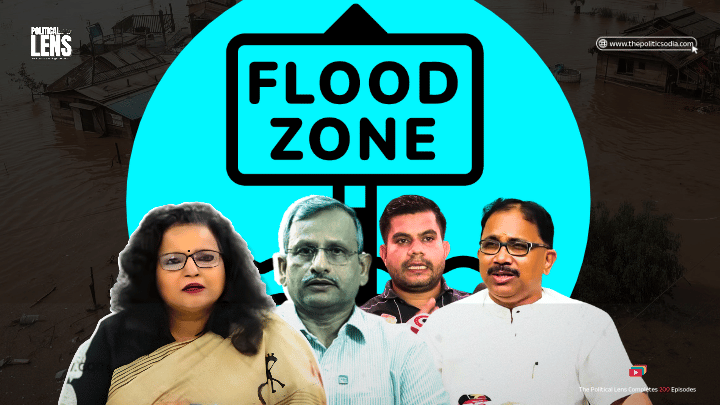 AnalysisNovember 12, 2026Ganjam Flood Politics Intensifies: Anu Garg Defends Government, Anil Biswal Hits Back at Suresh Mahapatra as Relief Package Announced
 AnalysisNovember 11, 2026Ganjam Flood: Natural Disaster or Administrative Failure? Naveen Patnaik’s Allegations Put Odisha Government Under Pressure
 AnalysisOctober 28, 2026Sujata Rout Karthikeyan’s Emerging Role in BJD as Naveen Patnaik Targets BJP
 AnalysisOctober 27, 2026Kotia Dispute: Mohan Majhi Replies to Naveen Patnaik, Calls for Legal Solution Over Political Debate