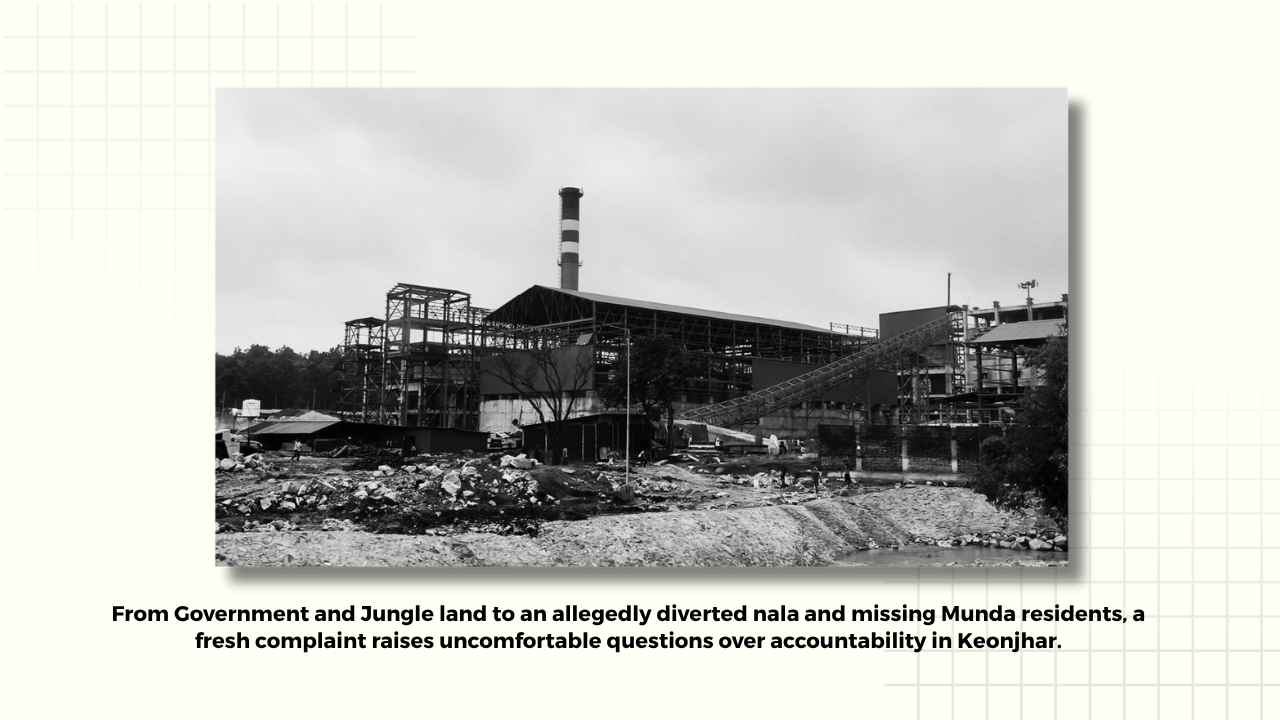
From Government and Jungle land to an allegedly diverted nala and missing Munda residents, a fresh complaint raises uncomfortable questions over accountability in Keonjhar.
By Sunil Jena
Editor-in-Chief, The Politics Odia
Bhubaneswar : Keonjhar is once again at the centre of a serious controversy over land, mining and tribal rights. This time, the allegations are not limited to mining operations. They involve Government land, Jungle-category land, alleged diversion of a long-standing nala, extraction of natural stone, an Intake Well and, most seriously, claims concerning Munda tribal families and missing residents.
At the centre of the controversy is the industrial activity of Kashvi International Private Limited at Champadihi in Jhumpura Tahasil.
The Politics Odia has examined a set of documents relating to the project, including a 2020 IPICOL letter concerning land for Kashvi International’s iron ore beneficiation and pelletisation facilities and a separate representation/complaint alleging several statutory violations.
The documents do not establish that all the allegations are true. But they do provide enough specific details for the concerned authorities to verify the claims through land records, field inspection, mining records and other statutory documents.

What the 2020 IPICOL letter says
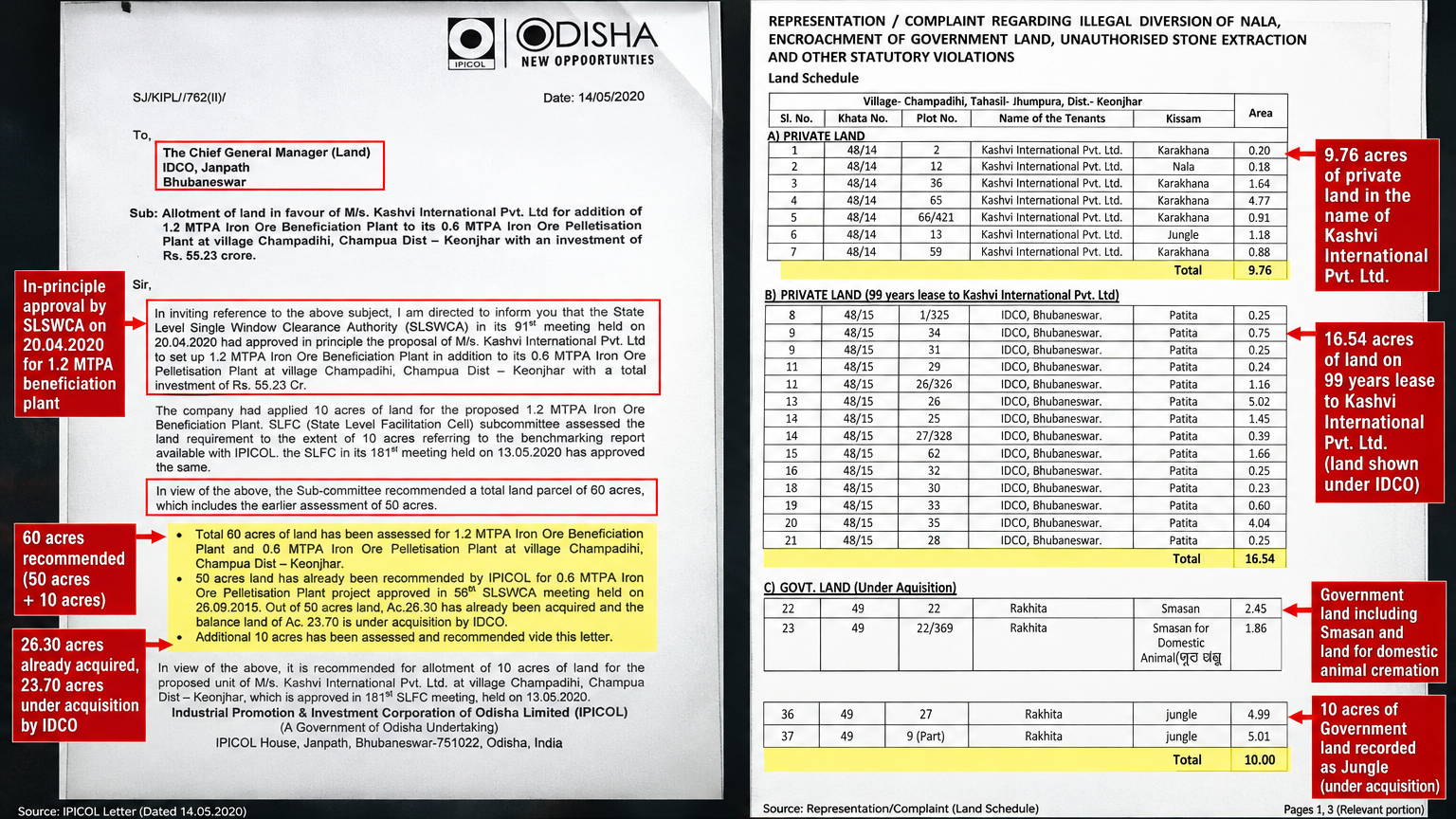
A letter dated May 14, 2020, issued by the Industrial Promotion & Investment Corporation of Odisha Limited (IPICOL) to the Chief General Manager (Land), IDCO, concerns the proposed addition of a 1.2 MTPA iron ore beneficiation plant to Kashvi International’s 0.6 MTPA iron ore pelletisation plant at Champadihi.
The letter says the State Level Single Window Clearance Authority had approved the proposal in principle at its 91st meeting held on April 20, 2020. The investment mentioned in the document was Rs 55.23 crore.
The company had applied for an additional 10 acres for the beneficiation plant. The IPICOL document says a total of 60 acres had been assessed for the beneficiation and pelletisation projects.
Of the earlier 50 acres recommended for the pelletisation plant, 26.30 acres had already been acquired, while acquisition of the remaining 23.70 acres was stated to be under process by IDCO.
The additional 10 acres was assessed and recommended for the proposed beneficiation plant.
On its own, this letter does not show any illegality. What it does show is the official land-allotment trail for the project at that point in time.
And that becomes important when compared with the allegations contained in the later complaint.
The land records raise another set of questions
The complaint submitted regarding the Champadihi project contains a detailed land schedule.
It lists 9.76 acres of private land in the name of Kashvi International Private Limited. It also lists 16.54 acres of private land described as being on a 99-year lease to Kashvi International, with the land shown under IDCO, Bhubaneswar.
The same schedule identifies Government land, including land recorded as “Rakhita Smasan”, land associated with domestic-animal cremation and other Government categories. Another 10 acres is shown as “Rakhita Jungle” under Government land under acquisition.
This is where the real issue begins.
The question is not simply how much land was recommended in 2020. The question is whether the land actually being used on the ground matches the legally acquired, allotted or leased land and whether every required permission was obtained for each category of land.
That is something only a proper official demarcation can settle.
Allegation of a nala being diverted
The complaint makes a specific allegation about a nala passing over Plot No. 60 under Khata No. 52.
According to the complaint, the company diverted the nala without obtaining the required statutory permission. Local villagers are quoted as saying that the water channel has existed for around 200 years.
The complainant says the alleged diversion has affected water availability for agriculture and the daily livelihood of villagers.
The complaint has asked the authorities to verify the original course of the nala, its catchment and downstream flow. It has also sought restoration of the original course if the diversion is found to have taken place illegally.
If that allegation is established, this would not be merely a dispute between a company and local residents. It would involve a public water resource and people dependent on it.
Natural stone extraction and the question of Government revenue
The complaint also alleges that a substantial quantity of natural stone was extracted and used for construction without the necessary permission.
It specifically raises the possibility of violations of applicable mining, environmental and minor-mineral rules, including the Odisha Minor Minerals Concession framework.
This is another allegation that can be checked on the basis of records.
How much stone was extracted? From which location? Was there a permit? Was royalty paid? Where was the material used?
The complainant has asked the authorities to determine the source and quantity of the stone and verify its permit and royalty status.
If unauthorised extraction is established, the issue would also raise the question of possible loss of Government revenue.
The 50-acre Government land allegation
The complaint alleges that around 50 acres of Government land was encroached upon or used without lawful authority. It specifically refers to land recorded as Smasan, Jungle and land reserved for the cremation of domestic animals.
The complainant has sought a survey and demarcation of these parcels and verification of the relevant Record of Rights and cadastral maps.
Again, this is a matter that should be decided by records and measurement—not political claims.
Forest and environmental compliance
The complaint also raises concerns about the use or disturbance of land having recorded Jungle/forest characteristics. It alleges that the activities may have been undertaken without obtaining all applicable statutory approvals.
The document specifically asks authorities to verify forest clearances, environmental clearances, mining or minor-mineral permissions and water-related approvals.
Whether there was a violation or not can be established by comparing the actual activity on the ground with the approved project documents and statutory permissions.
What about the Intake Well?
Another point raised in the complaint is an Intake Well allegedly constructed or operated by the company.
The complainant has asked for verification of its location, construction, source of water and quantity of water being drawn, along with its possible effect on local water resources.
The complaint further claims that the nala diversion and Intake Well could affect the Kanpur Major Irrigation Project, which serves parts of Keonjhar, Mayurbhanj and Bhadrak.
A technical and hydrological assessment has therefore been sought to determine whether there is any actual impact on the irrigation system or downstream users.
Then comes the most disturbing allegation
The controversy has now taken a much more sensitive turn with allegations concerning members of the Munda tribal community.
It is being alleged that more than 100 acres of tribal land have come under private control and that more than 30 Munda tribal residents have gone missing.
These are extremely serious allegations. The documents examined for this report do not independently establish either claim.
That distinction is important.
The allegation concerning the 100-plus acres needs to be checked against the Record of Rights, mutation documents, acquisition proceedings, land-transfer records and actual field demarcation.
The allegation concerning missing Munda residents requires an entirely different level of verification—police missing-person records, complaints from families, local administrative records and statements from members of the community.
But the seriousness of the allegation is precisely why it cannot simply be brushed aside.
The Politics Odia has spoken to a local person who has raised concerns about the situation. For security reasons, the person’s name, address, face and voice have been withheld.
Where does Mohan Majhi come into the controversy?
There have also been allegations about the alleged proximity of Kashvi International’s leadership to Chief Minister Mohan Charan Majhi. The documents examined for this story do not establish that such a political relationship resulted in any regulatory favour or inaction. Therefore, that claim needs to remain an allegation unless supported by documentary evidence.
The more important question for the government is straightforward: Were the complaints independently investigated by the departments responsible for revenue, mining, forest, water resources and pollution control?
If the project is fully compliant, the records should establish it.
If violations have occurred, the same records should lead to action.
Why PM Modi and Jual Oram are being asked to take note
The allegations now involve tribal land and the reported disappearance of members of the Munda community. That is why calls are being made for the Union government to take note of the matter.
Prime Minister Narendra Modi is currently the Prime Minister of India, while Jual Oram is the Union Minister for Tribal Affairs.
The demand for their attention does not mean that the allegations have already been proven. Rather, the argument is that a matter involving alleged tribal-land violations and missing tribal residents deserves examination through the appropriate legal and administrative mechanisms.
The documents themselves point to what should happen next
The complaint does not merely make allegations. It also asks for specific action.
It seeks joint inspection and demarcation of the land, verification of Ro Rs and cadastral maps, examination of the alleged nala diversion, verification of Government land, scrutiny of forest and environmental permissions, investigation into stone extraction and inspection of the Intake Well.
It further asks that appropriate action be taken if violations are established.
In other words, there is a straightforward way to settle the controversy.
Go to the site. Check the records. Measure the land. Examine the approvals. Verify the stone extraction. Check the water channel. Verify the missing-person claims.
Then publish the findings.
Keonjhar’s mineral wealth is important to Odisha’s economy, but mineral development cannot come at the cost of lawful land rights, public water resources or the rights of tribal communities.
The allegations surrounding the Kashvi project are serious enough to warrant transparent verification. At the same time, allegations should not be converted into conclusions before the competent authorities establish the facts.
That is where this story now stands.
Sunil Jena’s Observation:
The documents show that the Kashvi project has a clear land and approval trail, but the separate complaint raises specific questions about Government land, Jungle-category land, nala diversion, stone extraction and water use. The allegations concerning more than 100 acres of Munda tribal land and more than 30 missing residents are particularly serious and need independent verification. The next step should be a transparent, time-bound inquiry, with the findings made public.
Author Profile

- Sunil Jena is the Editor of The Politics Odia, an independent digital platform that delivers fearless political analysis, ground reports, and investigative stories from Odisha. Known for bold storytelling and grassroots connections, Sunil is shaping a new era of regional journalism.
Latest entries
 AnalysisSeptember 17, 2026Dilu’s Game, Mohan’s Trouble? 30 Munda Tribals Allegedly Missing, 100+ Acres of Tribal Land Under Question, PM Modi Must Take Note : Super Exclusive
 AnalysisSeptember 11, 2026Thank You, Naveen Babu? BJD’s MMDR Protest Raises Questions Over Leadership and Political Strategy
 AnalysisSeptember 9, 2026CM in Dubai, Mining Mafia in Keonjhar? Who Is Protecting Odisha’s Mineral Wealth?
 AnalysisSeptember 7, 2026Why Is Mineral-Rich Odisha Still Poor? Radhakanta Sethi Takes on the MMDR Bill in Debate with Sunil Jena